Published . Study version 1.0.0.
How Much Expected Loss Does A -110 Parlay Have?
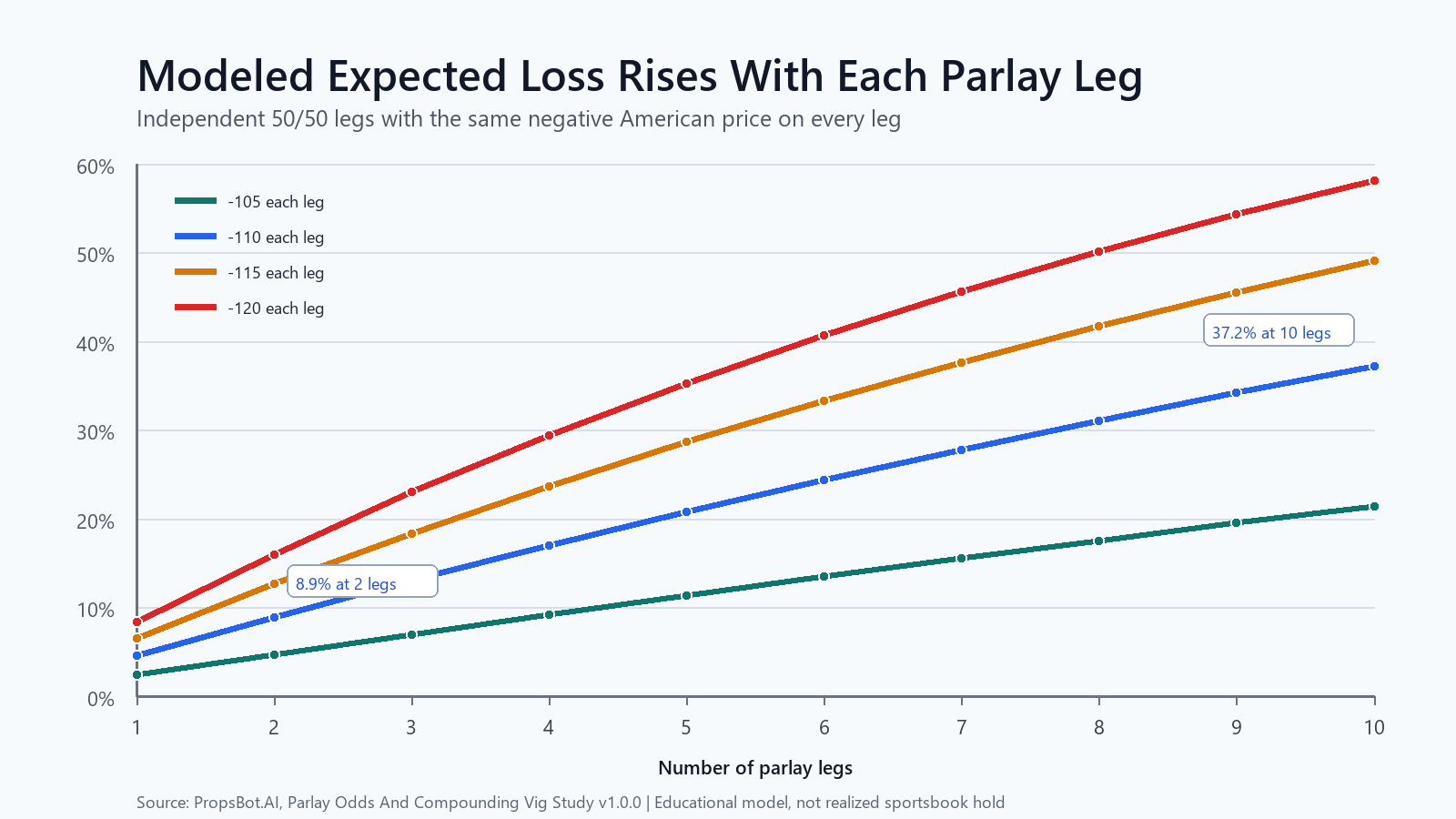
When independent 50/50 outcomes are each priced at -110, the modeled expected loss rises from 4.545% on one leg to 8.884% on two legs, 16.979% on four legs, 24.355% on six legs and 37.199% on ten legs. The advertised payout becomes larger as legs are added, but the fair payout grows faster. That widening difference is the compounding effect measured in this study.
This is a mathematical model, not a report of any sportsbook’s realized revenue or a claim about a particular bettor. It assumes every leg is truly 50/50, independent of the other legs and priced with the same negative juice. Real parlays can include unequal probabilities, pushes, rounding and correlation adjustments.

The -110 Result At A Glance
| Legs | Modeled expected loss | Winning profit on $100 | Fair 50/50 profit | Profit shortfall |
|---|---|---|---|---|
| 2 | 8.884% | $264.46 | $300.00 | $35.54 |
| 3 | 13.026% | $595.79 | $700.00 | $104.21 |
| 4 | 16.979% | $1,228.33 | $1,500.00 | $271.67 |
| 5 | 20.753% | $2,435.91 | $3,100.00 | $664.09 |
| 6 | 24.355% | $4,741.27 | $6,300.00 | $1,558.73 |
| 7 | 27.793% | $9,142.43 | $12,700.00 | $3,557.57 |
| 8 | 31.076% | $17,544.64 | $25,500.00 | $7,955.36 |
| 9 | 34.209% | $33,585.23 | $51,100.00 | $17,514.77 |
| 10 | 37.199% | $64,208.16 | $102,300.00 | $38,091.84 |
The table reports profit, not total return. A $100 two-leg parlay in the model returns $364.46 including stake, so the winning profit is $264.46. The fair return for two independent 50/50 outcomes is $400 including stake, or $300 profit.
Why A Bigger Payout Can Still Cost More
A parlay multiplies the decimal price of every leg. At -110, one leg pays 1.9090909 in decimal odds. Two identical legs pay 3.6446281, four pay 13.2833 and ten pay 643.0816 before any display rounding.
The true probability also multiplies. Under the study’s 50/50 assumption, two independent legs win 25% of the time, four win 6.25% and ten win 0.097656%. The fair decimal prices are therefore 4.0, 16.0 and 1,024.0. The difference between those fair prices and the modeled book prices grows with each additional leg.
The useful comparison is expected return, not the size of a winning screenshot. A large potential profit can coexist with a lower expected return because the chance of collecting it is small and every leg carries a price above its assumed fair probability.
The Formula
For negative American odds a and n independent legs:
decimal odds per leg = 1 + 100 / abs(a)
parlay decimal odds = decimal odds per leg ^ n
true parlay probability = 0.5 ^ n
expected return = true parlay probability * parlay decimal odds
modeled expected loss = 1 - expected return
At -110, the expected return of a single 50/50 leg is 0.5 x 1.9090909 = 0.9545455. For an n-leg parlay, the modeled expected return is 0.9545455 ^ n. Subtracting that value from one gives the expected loss shown in the table.
Readers can test live combinations with the free parlay calculator. The study explains the cost model; the calculator handles the actual odds a user enters.
Four-Leg Parlays At Different Prices
| Price on each leg | Winning profit on $100 | Fair profit | Modeled expected loss |
|---|---|---|---|
| -105 | $1,352.98 | $1,500.00 | 9.189% |
| -110 | $1,228.33 | $1,500.00 | 16.979% |
| -115 | $1,121.69 | $1,500.00 | 23.644% |
| -120 | $1,029.71 | $1,500.00 | 29.393% |
Small price differences matter more after multiplication. Four -105 legs retain more of the fair payout than four -120 legs under identical probability assumptions. This is why shopping each component price can matter even when the selections themselves do not change.
PropsBot’s player-prop line-shopping study measured real same-line price dispersion across five sportsbooks. That research and this parlay model answer different questions: the first measures observed price variation, while this study isolates the mathematics of compounding juice.
Break-Even Probability Is Not A Prediction
A two-leg -110 parlay in the model pays 3.6446 decimal, which corresponds to a 27.438% break-even probability. The true probability under the study assumption is 25%. The 2.438 percentage-point gap is not a forecast; it is the difference between the probability needed to break even at the posted payout and the probability assumed by the model.
Use the implied probability calculator to convert one posted price, or the no-vig fair odds calculator when both sides of a market are available. A model estimate should be compared with the price, not confused with it.
What Changes In A Same-Game Parlay?
This study assumes independence. Same-game outcomes often are not independent. A quarterback passing over and a receiver gaining over may share a favorable game script; two players competing for the same usage may work against one another. Sportsbooks can adjust the combined payout when legs are correlated.
That means multiplying the displayed decimal odds by hand may not reproduce a same-game parlay quote. The sportsbook’s final ticket is the authoritative payout. The right response is not to force the independence formula onto a correlated market, but to compare the offered combined price with a probability model that accounts for the relationship.
Exact Study Method
- Set the true probability of every leg to 0.5.
- Assume all legs are independent and that there are no pushes or voids.
- Evaluate one through ten legs at -105, -110, -115 and -120.
- Convert each negative American price to decimal with
1 + 100 / abs(a). - Raise the decimal price to the number of legs to calculate the unrounded parlay return.
- Raise 0.5 to the number of legs to calculate the assumed true parlay probability.
- Multiply probability by decimal return to calculate expected return.
- Subtract expected return from one to calculate modeled expected loss.
- Use a $100 stake for the payout and profit-shortfall tables.
The versioned package contains 40 scenarios in aggregate CSV and JSON, a scenario-and-chart generator, a 1,600 x 900 PNG and SHA-256 checksums. Re-running the generator produces the same values. The full assumptions and formulas are also stated on this page so the headline does not depend on an unavailable black box.
Open The Study Data And Source
Version 1.0.0 is public so readers can inspect the assumptions, reproduce every row and verify that the chart matches the table. Each link opens a labeled section on the permanent source page.
A Worked Four-Leg Example
Take four independent outcomes that are each truly 50/50 and offered at -110. One -110 price converts to 1.9090909 decimal. Multiplying that return four times produces 13.2833 decimal, or $1,228.33 profit on a winning $100 ticket.
The assumed true probability of winning all four legs is 0.5 x 0.5 x 0.5 x 0.5 = 0.0625, or 6.25%. Multiplying 6.25% by the 13.2833 decimal return gives an expected return of approximately 0.83021 per dollar staked. The remaining 0.16979 is the study’s 16.979% modeled expected loss.
The offered payout requires the parlay to win about 7.528% of the time to break even, while the stated model assumes 6.25%. That difference is why a ticket can have an eye-catching payout and still be unfavorable under the chosen probabilities. A bettor who believes the combined outcome wins more than 7.528% of the time would reach a different conclusion, but that belief needs evidence rather than the payout alone.
What Line Shopping Can And Cannot Change
Line shopping can improve the return without changing the selections. If the same four 50/50 legs are available at -105 instead of -110, the modeled expected loss falls from 16.979% to 9.189%. The ticket remains difficult to win, but less of the fair payout is surrendered through price.
Shopping cannot rescue a poor probability estimate. A better price helps only when the underlying assessment is sound and the market definitions match. It also cannot make correlated legs independent. For that reason, compare the exact line and price, confirm how the platform grades the market and use the final quoted parlay payout rather than a remembered rule of thumb.
The expected value calculator can test a probability estimate against one offered price. The study’s purpose is narrower: show why the cost embedded in each leg does not disappear when the legs are combined.
Limitations
- Simplified probability: real selections are not all true 50/50 outcomes.
- Independence: the model does not price correlation.
- Uniform juice: every leg in a scenario uses the same price.
- No ticket rules: pushes, voids, payout caps, boosts, promotions, taxes and cash-out offers are excluded.
- No rounding: calculations use full decimal precision; a sportsbook can round displayed or combined odds.
- No outcome sample: this is deterministic math, not historical win rate, ROI or operator revenue.
How To Use The Result
Start by asking whether every leg would be acceptable on its own. Then compare the live price on each leg, check whether the outcomes are correlated and calculate the combined payout before submitting the ticket. Adding a weak leg solely to increase the advertised return usually changes more than the headline number; it also changes the probability required to justify the wager.
For current ticket math, use the PropsBot parlay odds and payout calculator. For broader process guidance, read player props versus parlays and the odds-shopping guide.
How To Cite This Study
Suggested citation: PropsBot.AI, Parlay Odds Study: How Vig Compounds Across 2-10 Legs, version 1.0.0, July 19, 2026. Link to this permanent page and retain the 50/50, independence and uniform-juice assumptions when summarizing the result. The versioned source page contains the exact evidence files used here.
Study FAQ
Does a ten-leg parlay always have a 37.199% expected loss?
No. That result applies only to ten independent true 50/50 outcomes, each priced at -110 and multiplied without rounding or correlation adjustments.
Why not call this sportsbook hold?
Realized hold depends on the tickets a sportsbook accepts, outcomes, pricing, promotions and customer behavior. This study reports modeled expected loss under fixed assumptions, which is the narrower and more accurate label.
Can better predictions overcome the price?
A bettor needs an estimated true probability high enough to exceed the break-even probability implied by the combined payout. Prediction quality and price both matter; neither makes the other optional.
This study is educational. Sports betting involves risk, and no model or historical result guarantees a future return.